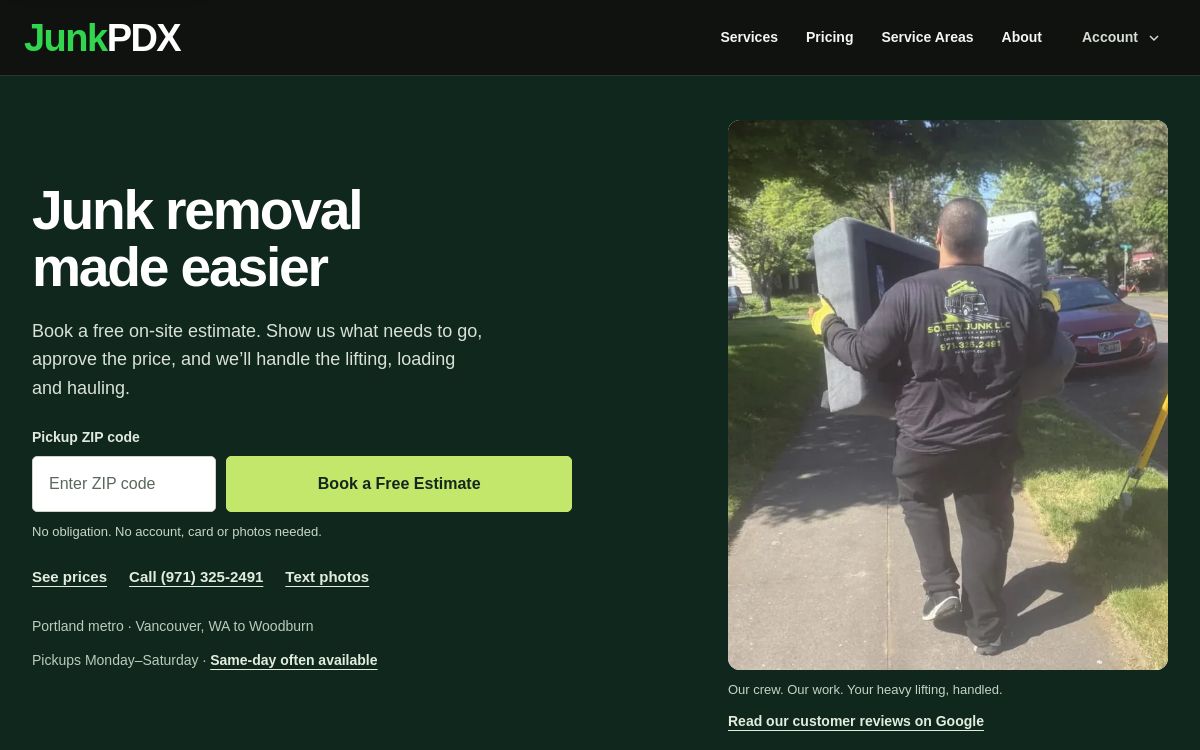
A junk removal website has a practical job: explain what happens, help people understand the price, and make the next step easy to find. JunkPDX brings those decisions into the first visit.
JunkPDX is owned by Alex, who also runs PDX Web Services. This project shows work on his own operating business and the customer experience behind it.
THE DESIGN DIRECTION
Show the work. Explain the next step.
The design pairs a dark green identity with a bright estimate action and a real photo of the crew at work. The introduction explains the complete service—lifting, loading and hauling—before asking a visitor to book a free estimate.
THE FIRST SCREEN
Make the service understandable.
A short introduction describes the on-site estimate and price approval. The ZIP field and estimate button sit alongside links to prices, a phone call and photo estimates, giving customers a clear starting point and ways to ask a question.
PRICE & EXPECTATIONS
Answer before asking for a commitment.
Pricing information explains that standard household junk is priced mainly by the truck or trailer space it uses. Customers can compare load sizes, then book a free estimate without choosing a load size. The full price is approved before loading.
USEFUL CONTENT
Give different jobs their own context.
Item guides, cleanout services, pickup areas and accepted-item information help people check their own situation. Completed-job photos connect the service description to real work, while FAQs cover access, preparation and the estimate visit.
THE CUSTOMER JOURNEY
A path through the important decisions.
Understand the pickup.
See what the crew handles, check the service area and explore relevant items or cleanout services.
Book a free estimate.
Follow the estimate booking path and share the job details. Customers approve the final price on site before work begins.
Approve the work on site.
Review the complete price before loading. For most standard pickups, the crew can load and haul during the same visit after approval.
Tell Alex about your business, the result you want and what caught your attention here. We’ll discuss a direction, a practical scope and a quote for your project.